
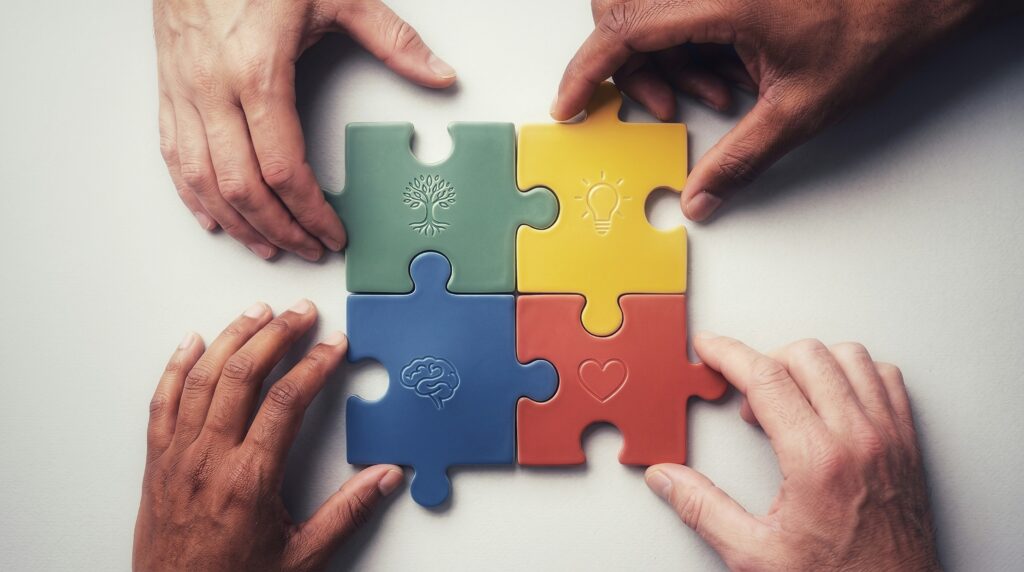
Liberatory facilitation is the practice of creating and holding group cultures in ways that actively work against the reproduction of oppression: centering the humanity, wisdom, and agency of all participants, particularly those who have been historically pushed to the margins by dominant systems. It draws on a foundational understanding that how we gather is never neutral. Every group space is either reinforcing existing hierarchies or working to dismantle them.
What I find exciting about this is that we have an opportunity to build cultures that reflect our values in our collective and organizations even before the broader culture reflects it. We get to “practice liberation” together! And this is how I believe we are going to have a worldwide revolution that takes down the existing norm, which is one that ranks human worth and prioritizes profit over everything else.
For anyone in a role of leadership in groups (whether you are an educator, professional facilitator, or leader in an organization), you are creating culture in the spaces you work. Culture impacts who feels at home, who is silenced, who is centered or marginalized. As a facilitator of culture, we have an opportunity to push against the status quo and build cultures where no one feels silenced or marginalized… or at least where we know how to do repair when that happens. When we lead with liberation in mind, it means we are thinking about these dynamics and using our influence on the cultures we are tending to to actively create something new and beautiful.
To that end, liberatory facilitation asks something different of the person holding the space: not to be an expert dispensing knowledge but a tender of conditions, building the ground in which people can access their own wisdom, stay in relationship when there is difficulty, and create something together that none of us could create alone.
This approach has deep roots. Paulo Freire named it in Pedagogy of the Oppressed – the insistence that education must be a practice of liberation rather than a transmission of information from expert to empty vessel. The Highlander Folk School lived it before anyone had a name for it; Rosa Parks trained there before the Montgomery Bus Boycott, and Septima Clark developed the citizenship schools there that would go on to train thousands of civil rights organizers. Ella Baker embodied it in her model of group-centered leadership, her conviction that the leader’s job is to develop the capacities of others and not to concentrate power in themselves.
More recently, adrienne maree brown has given this tradition new language in Emergent Strategy and Holding Change, the idea that how we move together in small groups is a fractal of the larger world we are trying to build. We are like the mushrooms at the bottom of the forest, building connected networks that influence how everything grows. Resmaa Menakem has named the somatic dimension: that healing racialized trauma and building genuine belonging across differences requires working with the body, not just the mind. Practitioners in the transformative justice movement, like Mia Mingus, generationFIVE, and others, have extended it into some of the hardest relational terrain imaginable.
What unites all of these lineages is a shared conviction about the role of the person holding the space. The facilitator is not a manager or someone who keeps things moving and makes sure everyone feels okay. The facilitator is someone who has done enough of their own work, examining their biases, knowing their nervous system, understanding how their identity and history shape what they see and don’t see, that they can hold a space that is truly transformative.
This work lives in the body as much as the mind. It asks us to be aware of what we notice and to wonder about what we miss. It asks us to stay present when things get hard rather than just smoothing things over. It asks us to believe that conflict, difference, and discomfort, handled with skill and care, are not problems to solve but conditions for real growth.
The quality of our collective life depends on the quality of our collective spaces. And this depends on the skill, the courage, and the self-awareness of the people who hold them.
I am passionate about supporting leaders and facilitators to step into their calling more fully. I truly believe that this is one way to change the world.
What to dive deeper into this work? Join me and others with similar visions and intentions this fall, online, for the Practicing Liberation: Leadership & Facilitation Training.